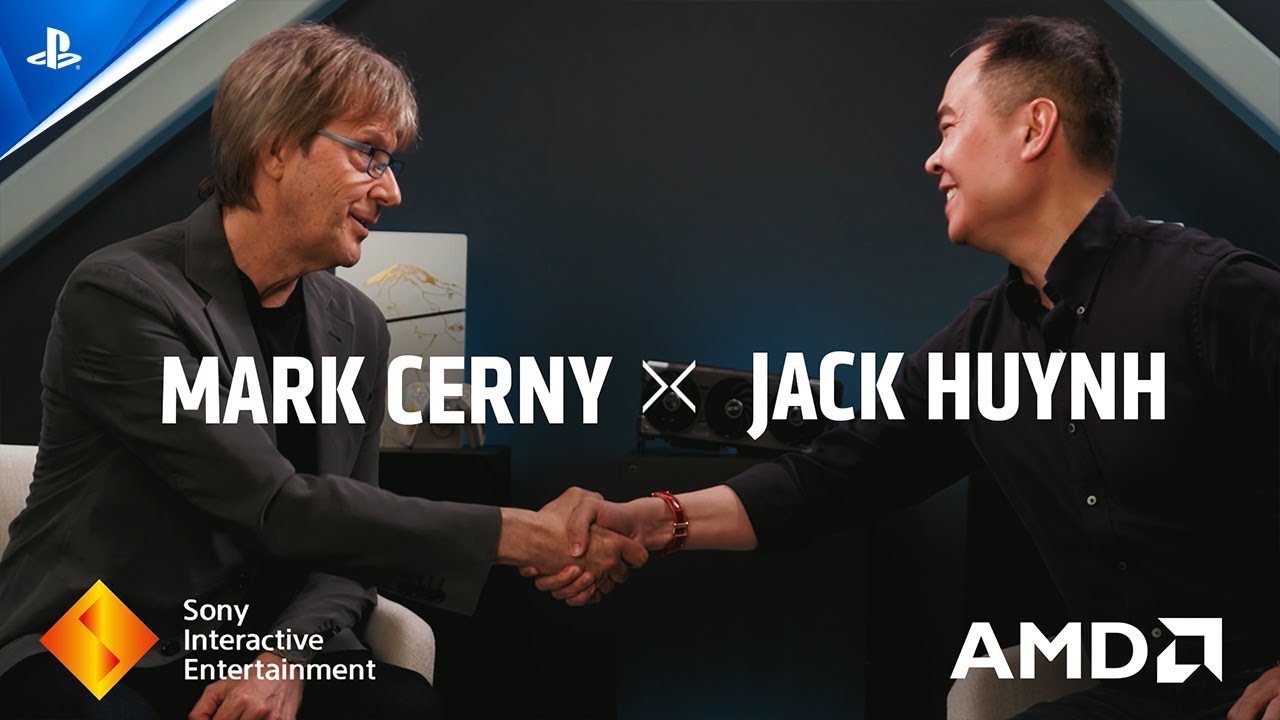
With Sony's PlayStation 6 now only a few years away (according to Sony), we have just received a whole new batch of information on the tech AMD is working on, and it makes me excited for what it will do for PC gamers.
AMD has been a long-time collaborator with Sony, with the PS4 using an AMD Jaguar CPU, and the PS5 housing an 8-core AMD Zen 2 CPU. Intel was reportedly in the running to develop the PS6's APU, but . Both the PS5 and PS5 Pro are built on RDNA 2 architecture, with the latter landing ""
There are three central updates shared in this presentation. The first is Neural Arrays. As Mark Cerny puts it, this collection of compute units (the compute blocks in an AMD GPU) pushed together to work as a single AI engine will "allow us to process a large chunk of the screen in one go". Cerny says the efficiencies that come from this new tech will be a "gamechanger" when it comes to the future of upscaling and denoising technology.
The second new bit of tech is called Radiance Cores. This is a specifically designed hardware block which is intended to handle ray tracing and path tracing in real time. In taking on the job of ray traversal, this frees up the load on the CPU to better work on tasks that CPUs are good at. Huynh sbfplay says this results in "a cleaner, faster, and more efficient pipeline built for the next generation of ray-traced games."

Nvidia cards are generally better at handling ray tracing than AMD ones, and this can be partially attributed to its dedicated RT cores. You can look at Radiance Cores as an attempt to try and bridge this gap.
The last new update shared in the latest video is Universal Compression, which is a system that can evaluate and compress all data within a GPU in order to reduce memory bandwidth usage. For the benefit of Universal Compression, Cerny cites "Lower power consumption, higher fidelity assets, and perhaps most importantly, the synergies that Universal Compression has with Neural Arrays and Radiance Cores."
Cerny clarifies that all of this technology "only exists in simulation right now, but the results are quite promising" and that he's "really excited about bringing them to a future console in a few years time."
Even if you don't particularly care about whatever Sony is up to for its next console generation, AMD working with Sony will be beneficial to the future of AMD as a business. As well as this, PCs and consoles have a symbiotic relationship. The PS5, when it launched, had pretty astounding storage architecture and was a mighty impressive device for its price. The PS5 had AMD tech that wasn't seen elsewhere prior to its release, too. With that in mind, whatever AMD creates for the PS6 will likely make the leap to PC too, potentially in RDNA 5.
The custom SoC (system-on-chip) was designed entirely for the device's unique parameters, but PlayStation Spectral Super Resolution (PSSR), Sony's AI upscaling technology built on FSR for PS5 Pro, will have improved FSR elsewhere after launch and vice versa. These advancements would have likely been developed side-by-side and influenced each other. This is before mentioning that Sony's financial support will have helped AMD over the last few decades, too.
Cerny ponders "to what degree the effective bandwidth of the GPU will exceed its paper spec", and this is something that consoles need to be very aware of. The finetuning of consoles allows them to crank out performance at a better efficiency, thanks in part to specific accommodations made on the software side. However, if upcoming AMD architecture can get more out of the same tech, the same is likely for the PC side too.
1. Best gaming laptop:
2. Best gaming PC:
3. Best handheld gaming PC:
4. Best mini PC:
5. Best VR headset:
👉👈